


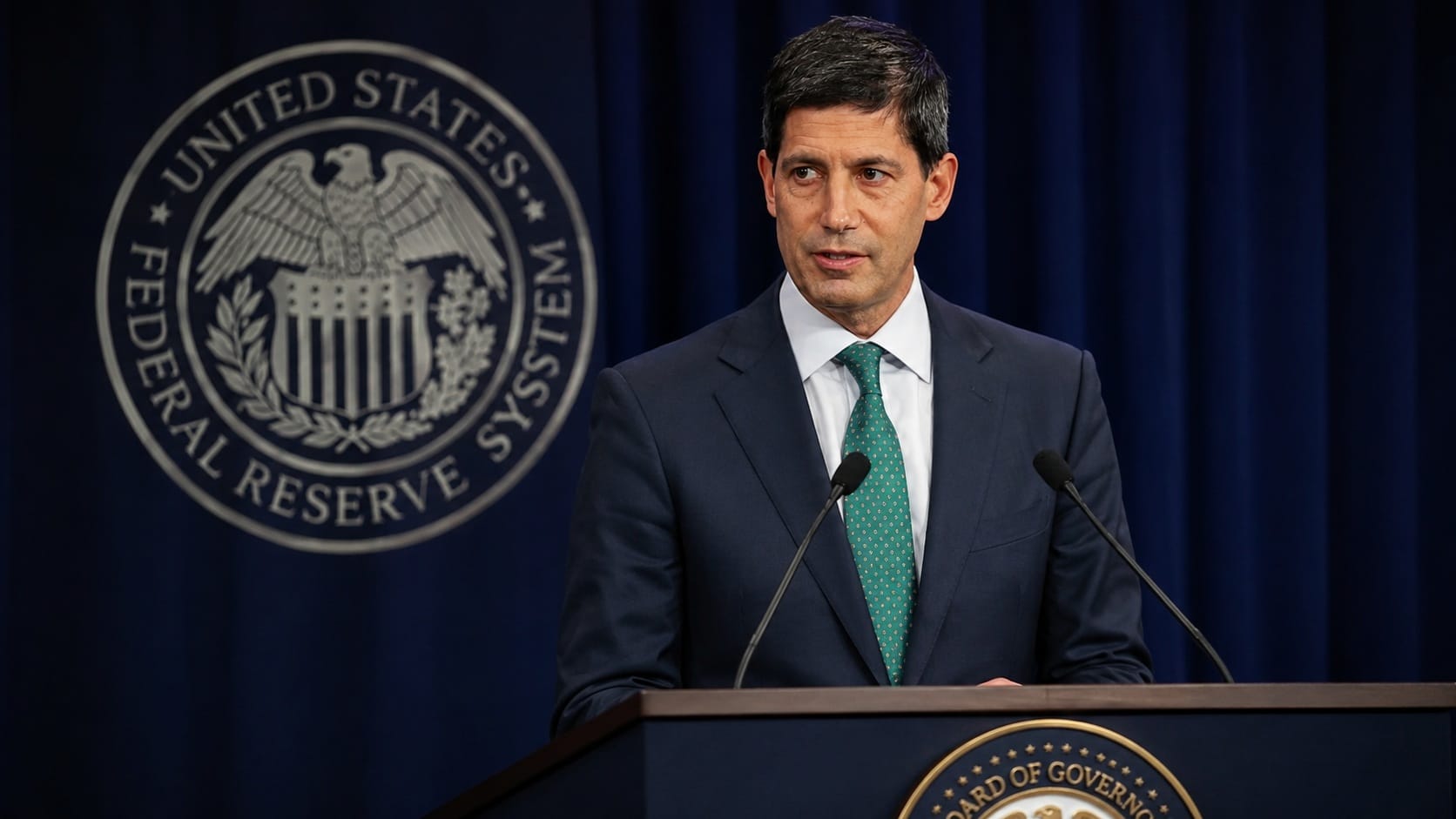
Most economists are focusing on the likelihood of a rate hike rather than a rate cut in the U.S. as new Fed Chairman Kevin Warsh prepares for his first two-day Federal Open Market Committee (FOMC) meeting since taking office.
According to a survey conducted by the Financial Times together with the University of Chicago Booth School of Business and the Clarke Institute, more than half of the 47 academic economists surveyed believe the Fed will need to raise rates by at least 25 basis points by year-end. Nearly 70 percent of participants also warned of significant downside risks in U.S. stock markets.
According to economists, Warsh’s monetary policy will be guided by economic data rather than President Donald Trump’s calls for rate cuts. With inflation in the U.S. hovering around 3.8 percent—near a three-year high—and well above the Fed’s 2 percent target, expectations for rate hikes are strengthening.
While more than 60% of economists expected an interest rate cut by year-end in the previous survey conducted in early March, the latest data suggests a sharp reversal in expectations. The latest survey was carried out during the period when the U.S.-Iran peace agreement was announced. The agreement is expected to restart maritime shipping through the Strait of Hormuz and alleviate pressure on global energy supplies.
Markets are hoping for a decline in oil prices and a reduction in inflationary pressure on gasoline prices in the U.S. as the deal is implemented. However, many economists believe that the previous increases in energy prices will continue to affect the real economy with a lag, and that inflation may remain elevated for some time.
Last Federal Reserve Interest Rate Decisions
The table below shows recent Federal Reserve interest rate decisions, market expectations, and the previous reported rate. Times are shown in Coordinated Universal Time (UTC).
| Date | Time (UTC) | Actual | Forecast | Previous | Signal |
|---|---|---|---|---|---|
| Jun 17, 2026 | 18:00 UTC | Pending | 3.75% | 3.75% | Upcoming |
| Apr 29, 2026 | 18:00 UTC | 3.75% | 3.75% | 3.75% | Hold |
| Mar 18, 2026 | 18:00 UTC | 3.75% | 3.75% | 3.75% | Hold |
| Jan 28, 2026 | 19:00 UTC | 3.75% | 3.75% | 3.75% | Hold |
| Dec 10, 2025 | 19:00 UTC | 3.75% | 3.75% | 4.00% | Cut |
| Oct 29, 2025 | 18:00 UTC | 4.00% | 4.00% | 4.25% | Cut |
| Sep 17, 2025 | 18:00 UTC | 4.25% | 4.25% | 4.50% | Cut |
| Jul 30, 2025 | 18:00 UTC | 4.50% | 4.50% | 4.50% | Hold |
| Jun 18, 2025 | 18:00 UTC | 4.50% | 4.50% | 4.50% | Hold |
| May 07, 2025 | 18:00 UTC | 4.50% | 4.50% | 4.50% | Hold |
| Mar 19, 2025 | 18:00 UTC | 4.50% | 4.50% | 4.50% | Hold |
| Jan 29, 2025 | 19:00 UTC | 4.50% | 4.50% | 4.50% | Hold |
| Dec 18, 2024 | 19:00 UTC | 4.50% | 4.50% | 4.75% | Cut |
| Nov 07, 2024 | 19:00 UTC | 4.75% | 4.75% | 5.00% | Cut |
| Sep 18, 2024 | 18:00 UTC | 5.00% | 5.25% | 5.50% | Cut |
| Jul 31, 2024 | 18:00 UTC | 5.50% | 5.50% | 5.50% | Hold |
| Jun 12, 2024 | 18:00 UTC | 5.50% | 5.50% | 5.50% | Hold |
| May 01, 2024 | 18:00 UTC | 5.50% | 5.50% | 5.50% | Hold |
Even if the Strait of Hormuz reopens, the effects of inflation will continue to be felt with a lag
Brandeis University economist Stephen Cecchetti, saying that the full terms of the deal are not yet clear, commented, “A significant portion of the upward inflationary pressures the market had anticipated has already begun to be passed on to the real economy.”
Pricing in Fed funds futures also signals that investors are keeping the possibility of a rate hike on the table through the end of the year, despite positive news regarding the U.S.-Iran ceasefire.
Analysts believe that FOMC members will give Fed Chair Warsh a break before hiking interest rates
Disagreements within the Fed are also said to complicate Warsh’s task. Although the market expects interest rates to remain unchanged at this week’s meeting, some FOMC members are signaling that a rate hike could be considered due to a strong labor market and resilient economic growth.
Joe Lavorgna, Chief Economist for the Americas at Sumitomo Mitsui Banking Corporation and a former Treasury advisor, believes that Trump’s calls for interest rate cuts will not be influential in Warsh’s decisions. Lavorgna stated, “The fact that the President supported interest rate cuts during the election campaign does not mean the Fed cannot raise rates. Interest rate decisions are based on economic fundamentals.”
Allan Timmermann of the University of California, San Diego, however, noted that an interest rate hike is a logical option from an economic perspective, though the FOMC might grant the new chair a brief adjustment period. Timmermann suggested that committee members might not want to impose aggressive tightening pressure immediately after Warsh takes office.
Prior to taking office, Warsh had said he aimed for a “paradigm shift” at the Fed, drawing attention to the importance of steps such as balance sheet reduction and reshaping the central bank’s communication system with the markets. According to Lavorgna, while Warsh will seek to change the current Fed consensus, he will do so gradually and cautiously.
Analysts believe there is a high probability that the S&P 500 index will fall by 20% over the next year
Another key finding in the survey was the valuation risk in U.S. stock markets. Around 70% of economists believe the probability of the S&P 500 index falling by 20% over the next year is higher than normal.
Timmermann argued that the recent market rally, which has largely been driven by technology and semiconductor stocks, creates a structural bubble risk. Robert Barbera of Johns Hopkins University added that valuations of risky assets are near their highest levels in the past 50 years, noting that the rise in U.S. debt levels is also increasing financial fragility.
Barbera thinks that markets are overly focused on short-term movements in consumer prices, while failing to adequately account for the financial risks accumulating in assets with high valuations, such as SpaceX.

1 Comment
Pingback: Fed Interest Rate Decision: September 2026 Update